
Put each exact model on its own order line
Start with a model reference and a piece quantity for each component. A description such as '5000 PET items' does not show whether the requirement is for one cup model or a mixture of cups, bowls and lids. Likewise, a common capacity or diameter does not turn separate models into one.
The comparison below uses three real catalogue references but hypothetical buying quantities. It illustrates only the minimum-order calculation. It is not a quotation or a statement that the cup, lid and bowl form one packaging system.
| Order line | Mixed request | Model-by-model minimum example |
|---|---|---|
| JY9806-500-16oz PET cup | 2000 pieces — below 5000 | 5000 pieces |
| JY-98FL PET flat lid | 2000 pieces — below 5000 | 5000 pieces |
| JY117-230-8oz PET bowl | 1000 pieces — below 5000 | 5000 pieces |
| Total pieces | 5000 pieces across three models | 15000 pieces across three models |
A cup and a lid are two pieces, not two sets
If your intended set contains one cup and one lid, record both component quantities. For a combination later verified and accepted for the intended use, 5000 cups plus 5000 lids would provide 5000 complete sets before allowing for any unavailable or unusable components. The order contains 10000 pieces, not 10000 sets.
JY9806-500-16oz and JY-98FL are only a candidate combination in this article. Their shared 98 mm catalogue diameter does not prove compatibility. Establish the pairing before treating the two purchase lines as a usable set.
For a second quantity example, 6000 cups and 5000 accepted matching lids would provide at most 5000 one-cup/one-lid sets, leaving 1000 cups without a lid from that purchase. Adding the two quantities and dividing by two would give the wrong answer. The component with the smaller usable count limits the number of complete sets.
Check the minimum and the packing unit separately
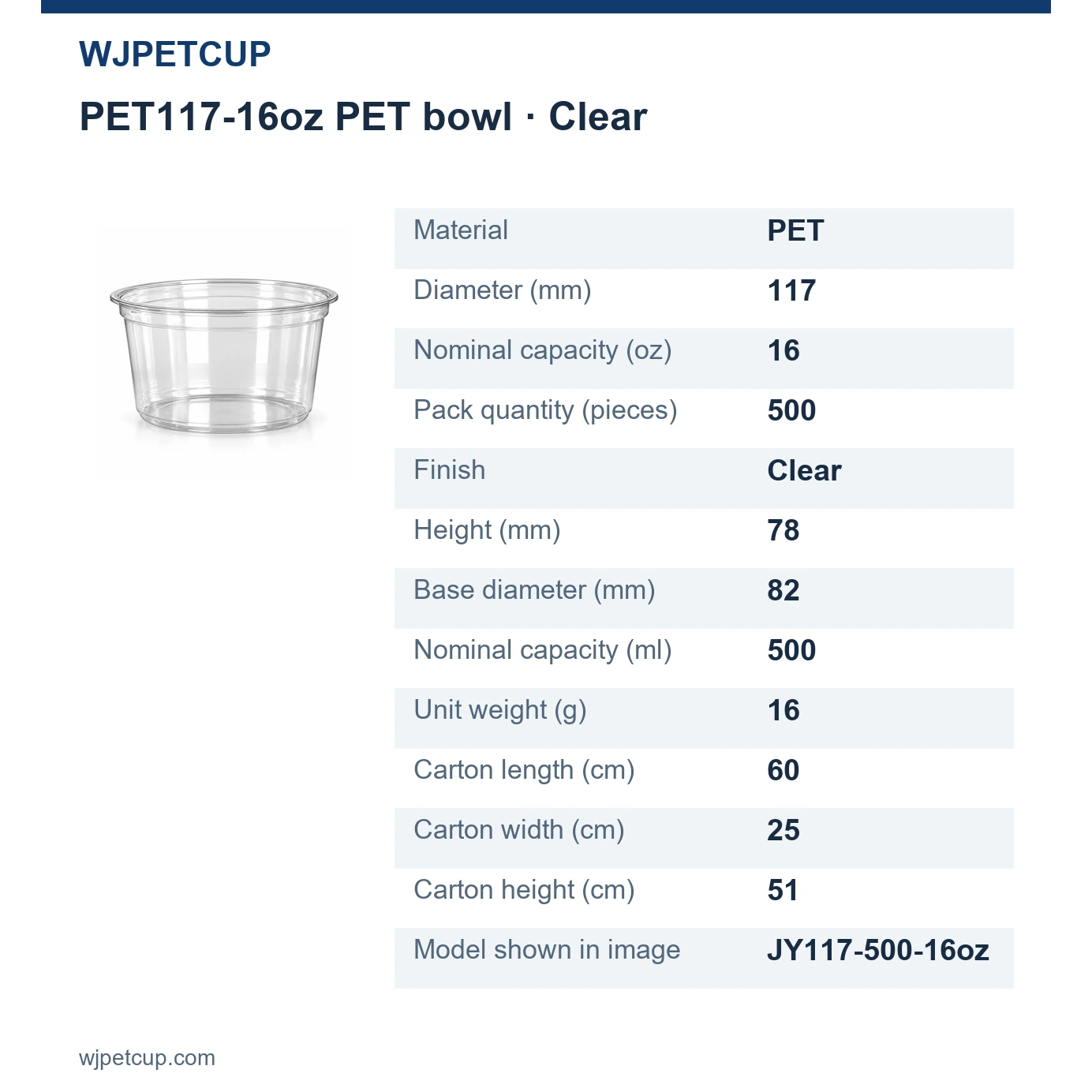
The minimum tells you the required quantity per model; a carton count describes packing. They answer different questions. The catalogue information for JY9806-500-16oz and JY-98FL lists 1000 pieces per carton, while JY117-230-8oz lists 500. Use those identified records when discussing packing rather than applying one number to every PET product.
At 5000 pieces per model, those catalogue counts correspond to five cup cartons, five lid cartons and ten bowl cartons. This is a calculation from the listed packing quantities, not a claim about an inspected shipment. Recheck the packing specification for the actual quotation.
| Model | Catalogue pieces per carton | Pieces in this example | Calculated cartons |
|---|---|---|---|
| JY9806-500-16oz | 1000 | 5000 | 5 |
| JY-98FL | 1000 | 5000 | 5 |
| JY117-230-8oz | 500 | 5000 | 10 |
Round up only when the packing agreement requires it
Suppose a buyer wants 5500 cups and the parties agree, for this hypothetical order, to supply only complete cartons containing 1000 cups each. Five cartons would supply 5000 cups, which is short of the request. Six would supply 6000, leaving 500 more than requested. The minimum-order rule has not changed; the extra quantity results from the assumed full-carton arrangement.
Under the same hypothetical full-carton rule, a model packed at 500 pieces per carton would need eleven cartons for 5500 pieces, with no excess. The general method is to divide the required pieces by the agreed pieces per carton and round the carton count up to a whole number.
Full-carton ordering is an assumption in this example, not a universal WJPETCUP condition established by this guide. Do not automatically increase a customer's quantity or promise a part-carton option. Agree the packing basis first, then show the resulting piece quantity and any excess explicitly.
Do not infer other order permissions from the model minimum
The per-model minimum does not, by itself, explain how an order can be divided between artwork versions, deliveries or destinations. A request for five designs of 1000 pieces each raises a different question from whether the cup model's total is 5000. State the design quantities and obtain the applicable arrangement rather than assuming that the arithmetic authorizes the split.
Sample quantities are another separate decision. The 5000-piece minimum is not a requirement to order 5000 printed samples. Record the proposed sample quantity and charges separately from the bulk component schedule.
Send a quantity plan that can be checked
A useful final quantity plan has the exact model, required pieces, intended set relationship, artwork allocation if relevant, agreed packing basis and resulting cartons. If any of these remain undecided, name the open question. Keep a calculated quantity separate from a quantity already accepted in the quotation.
After the model quantities are settled, use the carton-volume guide for transport planning and the production-schedule guide for dates. Quantity arithmetic does not determine freight cost or bulk lead time: WJPETCUP confirms the production duration against the actual order quantity, with transport considered separately.
Read more
Check your model-by-model quantity plan
Send each model and required piece quantity, any intended cup-and-lid sets, artwork splits and packing preferences. Identify whether a quantity is a target or already includes an agreed carton allowance.