
Revised ·
The same rim can sit above very different bodies
These six records share the 117mm rim description, but their listed heights range from 42mm to 145mm. The difference is in the body beneath the opening. That changes the physical envelope you need to evaluate, even before choosing a lid.
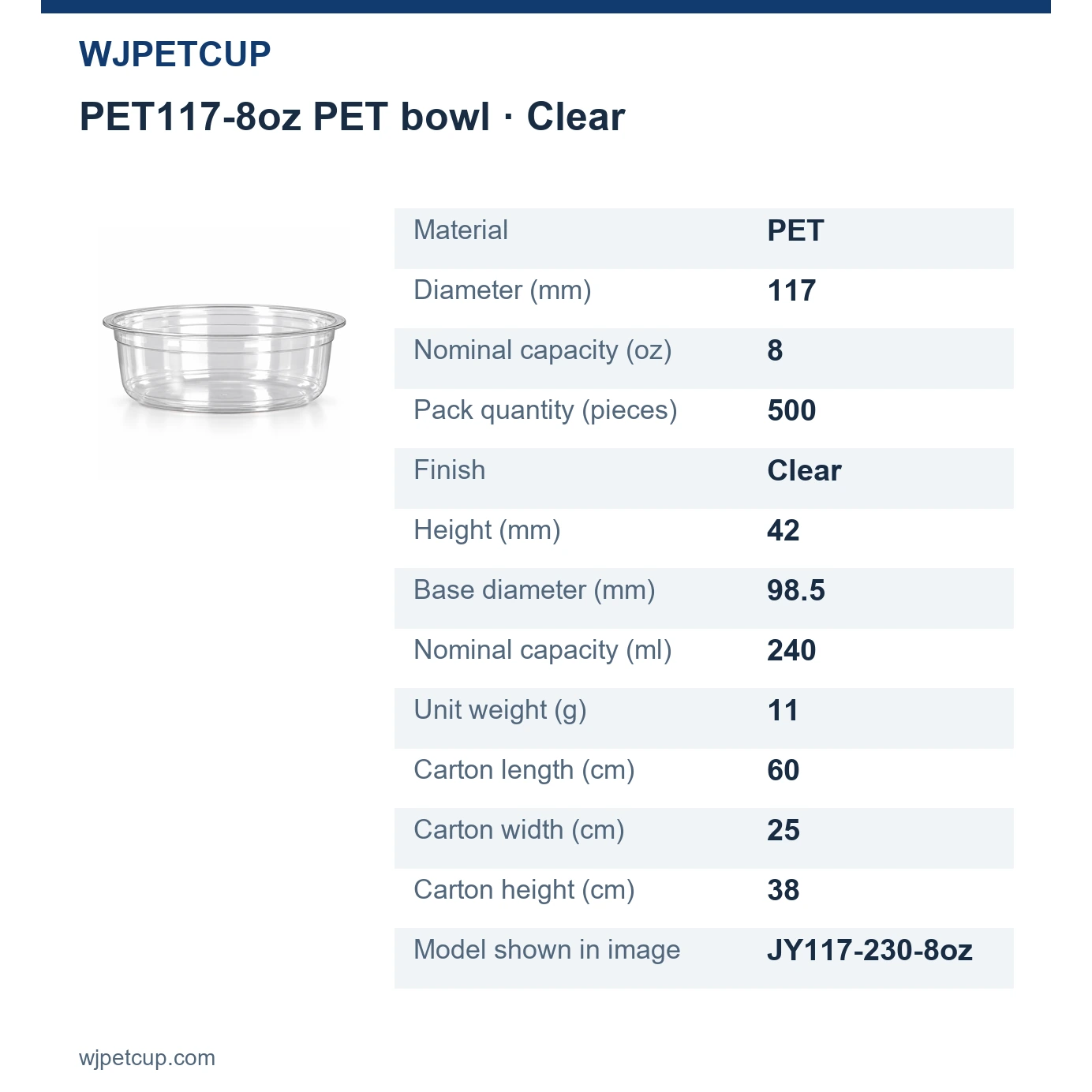
The table keeps capacity labels separate from body dimensions. It does not claim a measured filling level or a permitted portion weight. The company confirmed on 2026-11-06 that the 12oz JY117-360-12oz has a nominal capacity of 360 mL, a body height of 58 mm and a base diameter of 92.5 mm, so it is now included. The 360 mL figure is not a measured working-fill volume.
| Model | Catalogue size | Nominal capacity (mL) | Body height (mm) |
|---|---|---|---|
| JY117-230-8oz | 8oz | 240 | 42 |
| JY117-360-12oz | 12oz | 360 | 58 |
| JY117-415-14oz | 14oz | 420 | 70 |
| JY117-500-16oz | 16oz | 500 | 78 |
| JY117-24oz | 24oz | 780 | 105 |
| JY117-32oz | 32oz | 1000 | 145 |
Describe the portion's arrangement, not only its quantity
For a spoon-served product, decide whether the intended presentation spreads across a shallow layer or builds upward in layers. The 42mm and 70mm bodies offer different depths to evaluate for that arrangement. A taller body is not simply a larger version of the same visual presentation: the portion may sit lower relative to the rim, or use more vertical layering.
If the portion is specified by weight, do not rename that number as millilitres. A recipe with pieces, sauce and spaces between ingredients does not become a known container volume from its total mass alone. Keep the recipe quantity and the observed final level as separate entries in the sample record.
Treat proposed food or dessert uses as requirements to evaluate, not as a catalogue certification. Record the intended contents, contact conditions and serving method so the model's suitability can be checked for that use. No temperature limit or food-contact approval is established by this dimensional comparison.
Compare how the customer will reach the contents
The rim width stays the same in this comparison while body height increases. A spoon reaching the bottom of a 145mm body has a different path from one reaching the bottom of a 42mm body. The catalogue alone does not tell you whether the utensil and portion are comfortable to use together, but it identifies the depth change you should investigate.
Review the intended utensil with the filled sample and note where the customer must hold it. Evaluate access to the last part of the portion, not only the first spoonful. This gives a reason to compare two bowl depths beyond choosing whichever capacity number appears closest to the order brief.
For display planning, compare the complete closed package with the available shelf or compartment height. The 24oz and 32oz bodies are listed at 105mm and 145mm, a 40mm difference before the lid is considered. Added lid height and the space needed to remove the package must be evaluated separately. Body height alone is not a complete storage-clearance measurement.
Choose the top of the package around the finished portion
The PET lid catalogue includes JY-117FL and JY-117DM as flat and dome candidates. Their shared 117mm description is useful for finding them, but it is not evidence that either has been verified with every bowl in the table.
The top of the finished portion determines the clearance question. If the presentation has a raised element, record the space it needs beneath the closed lid. A dome-shaped image cannot supply an internal clearance measurement. Conversely, a flat lid should not be selected merely because the unfilled bowl looks shallow enough.
Keep the bowl model, lid model and portion arrangement together in the review. Changing only the lid can still change the space available above the serving and the assembly that needs to be checked. The fit-verification guide explains how to record that combination without treating a nominal diameter as an approval.
Make a comparison that can produce a clear decision
An illustrative comparison could place the same proposed portion in the 14oz and 16oz candidates, using the intended utensil and recording each candidate separately. The useful observations would be the final level, access to the contents, presentation and clearance with the proposed lid. Neither candidate is assumed to pass.
Keep portion preparation unchanged during the comparison. If the recipe or layout must change to make a candidate work, record that as a separate option rather than a direct comparison with the first serving. This preserves the distinction between choosing a different container and redesigning the portion.
Finish with a named bowl, a named lid and a short record of the observations still needed. Send those details to WJPETCUP with the intended order quantity. The catalogue can then support a specific selection discussion instead of leaving the request at “a 117mm bowl”.
Read more
Match a bowl shortlist to your portion
Send the exact bowl models, the intended portion arrangement and utensil, and the lid you want to evaluate. Include the available display or handling space when it affects the decision.