First identify which fluid ounce is meant
The US fluid ounce and the Imperial fluid ounce are different volume units. NIST's conversion table gives approximately 29.57353mL for one US fluid ounce and 28.41306mL for one Imperial fluid ounce. An ounce used for mass is a different quantity again; it is not the unit to use for a beverage-volume conversion.
For a volume explicitly stated in one of those systems, multiply by its corresponding factor. The rounded 16-fluid-ounce results below are unit calculations, not measurements of WJPETCUP cups. If a brief says only “16oz”, clarify the intended unit instead of silently selecting one.
| Explicit volume | Calculation | Rounded result |
|---|---|---|
| 16 US fl oz | 16 × 29.57353mL | 473.2mL |
| 16 Imperial fl oz | 16 × 28.41306mL | 454.6mL |
A catalogue size name is not automatically a conversion equation
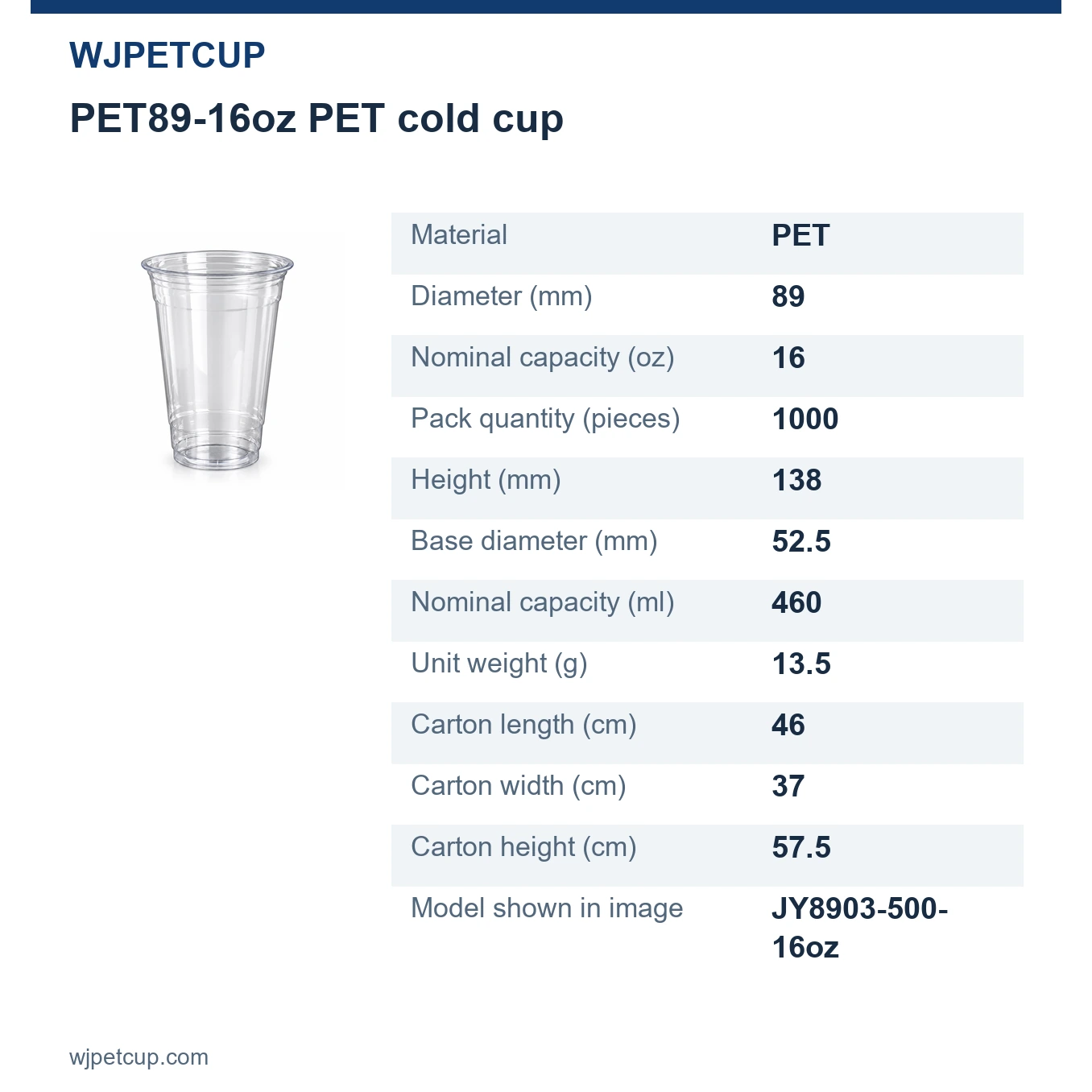
WJPETCUP's records list JY8903-500-16oz with a 16oz size label and a separate 460mL figure. JY9806-500-16oz is also labelled 16oz, with a 500mL catalogue figure. These are two model descriptions. They should not be rewritten as if each millilitre value were the exact mathematical conversion of the size label.
The supplied records do not establish the measurement method behind every capacity label, nor do they establish that every oz label declares a specific fluid-ounce system. Retaining both fields accurately is more useful than inventing an explanation for the difference. A purchase specification can then state the required volume and measurement basis independently.
The model number is an identifier, too. In JY8903-500-16oz, the presence of 500 does not override the separately recorded 460mL field. Use the complete model to identify the product, and use the applicable capacity record and agreed measurement to discuss volume.
Define the endpoint of any fill measurement
A brimful measurement and a working fill answer different questions. Brimful refers to a defined fill endpoint at the rim; a working fill refers to the intended serving level under specified use conditions. The supplied catalogue figures have not been verified here as either one. A number without its endpoint cannot settle the serving requirement.
If a cup has a fill line, ask the supplier to identify the mark and confirm its stated volume, unit and measurement method for the exact model. A line below the rim sets a different endpoint from a brimful measurement; the catalogue oz or mL value should not be assumed to refer to that line. A fill line alone does not establish the recommended serving. The records used here do not confirm whether either WJPETCUP example has a fill line or establish a verified volume at one.
For a cup supplied with a lid, the finished serving must also be considered with that lid. Record whether the assessment concerns liquid alone or the complete recipe with ice and other additions. The space between the serving and the lid is a separate observation, not a percentage that can be assumed for every cup.
Avoid deriving actual internal volume from outside diameter and height. PET cup bodies are not described completely by those two numbers, and the outside dimensions do not supply all of the internal geometry. The dimensions help choose candidates; a defined filling assessment addresses a different question.
Turn a recipe into an unambiguous sample brief
Consider an illustrative requirement for 300mL of measured liquid plus a specified ice portion. The 300mL describes the liquid added, not the total occupied volume of the finished serving. A cup labelled 300mL has therefore not been shown suitable merely because the two numbers match.
Keep the preparation method and ingredient quantities consistent while reviewing candidate cups. Record the actual final level and the proposed lid, then describe the observation using that exact sample identity. If you change the ice portion to make the drink fit, record that as a recipe change rather than evidence that the original serving requirement passed.
The record below is a suggested way to keep the questions separate. It is not a test standard, a completed measurement or a claim that a particular WJPETCUP cup has passed. Use an agreed measurement method suitable for the decision and retain the original readings.
| Record | What it makes clear |
|---|---|
| Exact cup and lid models; sample reference | Which physical combination was assessed |
| Liquid quantity and explicit volume unit | The measured liquid portion, separate from the size name |
| Ice and other additions; preparation sequence | What else contributes to the finished serving |
| Contents and temperature during the assessment | The conditions attached to the observation, without implying an approved temperature range |
| Measurement method and fill endpoint | What the recorded capacity or level actually means |
| Observed final level, clearance and unresolved points | The result for that preparation, rather than an assumed result from the catalogue |
Put the requirement and the evidence in different fields
A useful purchasing statement has two parts: the desired serving and the evidence that will be used to assess it. For example, identify the liquid portion and additions in the requirement, then identify the cup, lid, method and observations in the sample record. This prevents a catalogue label from becoming an unsupported performance commitment.
Send WJPETCUP the candidate model and the serving you intend to evaluate. Keep any unknown capacity basis visibly unresolved. Once the assessment is complete, retain its conditions with the decision so a later recipe, lid or model change does not silently inherit a result that no longer applies.
Read more
Define the fill requirement for your cup
Send the model, explicit liquid-volume unit, planned additions and intended lid. Explain the serving level or clearance you want to assess rather than relying only on an oz label.