
Choose a takeaway drink package as an assembled system. The lid must work with the exact cup and intended use; the carrier must support that filled cup; and the bag must accommodate the loaded carrier without interfering with the lids or the way the order is lifted out. A closed bag does not establish that the drinks inside will remain upright. Approve the combination for your actual order sizes and handling sequence before treating the cup-and-lid choice as a finished delivery solution.
This guide is for buyers who already have a PET cup and lid shortlist and now need to choose or retain the surrounding packaging. WJPETCUP's PET cup and lid records provide the product examples. Carriers, outer bags, sealing stickers and plugs discussed here are evaluation items, not confirmed WJPETCUP supply or compatibility claims.
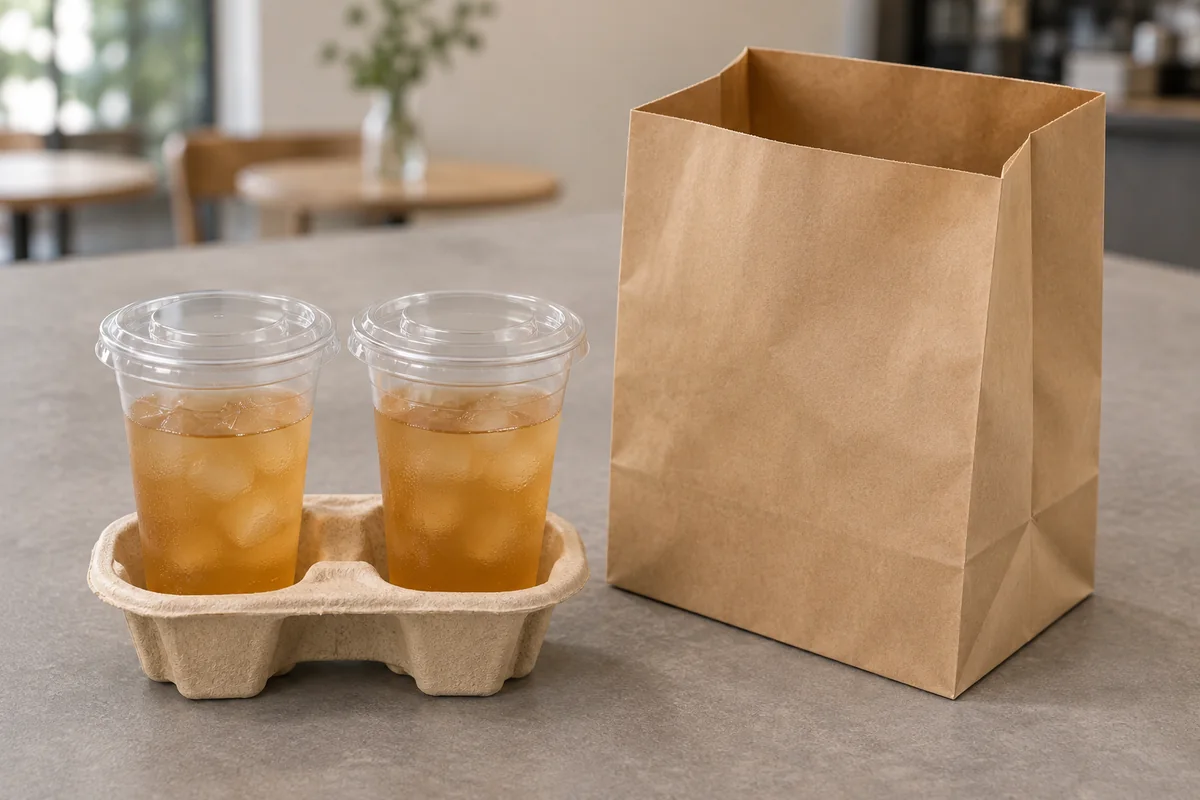
Give each part a separate job
A lid can remain seated while liquid escapes through an intended drinking opening. A carrier can hold the cups together while moving inside an oversized bag. Spilled liquid may collect inside a sealed bag even though closing that bag did not prevent the spill. Treat those as different observations, because changing the lid alone will not answer every packaging problem.
| Component | Decision to make | What its presence does not prove |
|---|---|---|
| Cup and lid | Identify the exact pair and how the drink will be filled, closed and consumed. | A tight-feeling rim does not prove that an open drinking feature can contain liquid during shaking or tipping. |
| Carrier | Check where it supports the cup body, how the cups are arranged and how the loaded carrier is held. | A stated cup-size range does not qualify every cup shape or loading pattern within it. |
| Outer bag | Check usable base space, closure space, handling and removal of the loaded carrier. | Closing or sealing a bag does not secure its contents against movement. |
| Seal or sticker | Specify whether it identifies an order, shows disturbance or closes a particular opening. | One purpose does not establish the others; a sticker is not evidence of a qualified liquid-tight closure. |
Start the assembly review after the specific cup-and-lid combination has been assessed. If the lid choice is still open, use the 98mm lid-style comparison first. Carrier selection cannot correct an unresolved closure requirement.
Same 98mm rim, same 16oz label: still check the carrier again
Two WJPETCUP cup models show why the rim and drink-size name are insufficient for the next step. These are separate cup models, not a recommendation that either fits a particular carrier.
| Exact model | Rim diameter | Cup height | Base diameter |
|---|---|---|---|
| JY9802-500-16oz (Style A) | 98 mm | 121 mm | 63 mm |
| JY9806-500-16oz (Style B) | 98 mm | 127 mm | 62.5 mm |
The confirmed cup heights are 121 mm for Style A and 127 mm for Style B. This 6 mm difference is for the cups without lids; it does not establish their assembled height or their fit with a carrier or outer bag. Check the clearance on the assembled samples: fit each lid, seat the cup in the carrier, then measure how far it projects above the carrier and how much space remains below the bag closure. The carrier may support each tapered cup at a different point.
Look at where the carrier touches the body, rather than comparing its opening only with the cup's base diameter. Then check whether the cup sits as intended, can be inserted without forcing the body, and can be removed without pulling on the lid. These dimensions do not establish which cup is more stable, how much weight a carrier can support or whether one carrier works with both models.
Carrier designs also differ. Huhtamaki describes several cup-count formats and an adjustable-divider design in its manufacturer's carrier range. That is a reason to review the actual construction and its instructions, not an endorsement of that supplier's carriers for the two cups above.
Choose the bag around the loaded carrier and the removal path
Measure the carrier after assembly and loading. A bag's nominal width or height may include folds, handles or closure material that is not usable internal space. Check the open base, the loaded package at its widest point, and the space above the highest lid. Look for a bag that allows the intended assembly and removal without pressing the lids or requiring the drinks to be tipped.
A very close fit can make removal awkward; a large loose bag may allow the carrier to slide or rotate. Do not solve either problem by guessing a universal clearance. Compare samples in the actual sequence: lower the loaded carrier into the bag, close it, lift and set it down as intended, open it, then remove the carrier or cups in the way the customer is expected to use.
Watch the lid edges during that final step. Contact with a bag fold, carrier handle or nearby object is a different question from whether the lid was properly fitted at the counter. Check this path in a stationary setup before delivery. Do not conduct a handling trial while driving or instruct recipients to lift a filled cup by its lid.
Compare a single-drink order with the intended larger orders
Approval for one fully occupied carrier does not establish performance when only one position is filled. Follow the carrier supplier's permitted loading arrangement and compare the order patterns you actually sell: a single drink, a pair, a full carrier and any intended mixed-size order. Record the positions used, because changing the load distribution changes the assembly being evaluated.
There is a procurement tradeoff. One carrier format can simplify stockholding, but may require more space or a less convenient packing sequence for small orders. Separate formats add stock items but may better suit those orders. Compare unit cost together with assembly time, bag size and observations from the actual permitted loads. Do not count hypothetical spill savings as proven savings.
For mixed drinks, keep the actual recipes and servings in the review. A carrier holding empty cups says little about the package handed to a rider. Record the finished serving and any additions separately from the catalogue capacity; use the fill-volume guide if that requirement is not yet defined.
Include the cold-drink waiting period
Ask the carrier and bag suppliers for the intended moisture exposure and handling limits, then compare the dry assembly with the assembly after your actual preparation-to-handover and delivery interval. Inspect both the carrier and the bag base or handles. A package that is easy to lift immediately after packing may present a different problem after waiting with cold drinks.
For a bounded material example, Sabert's 29501 technical sheet describes moisture-resistant paperboard, yet also limits refrigerated dwell time and warns that excessive moisture can soften it. This supports asking about wet-use limits. It does not establish the behaviour of every paper carrier, provide a universal safe waiting time or qualify that carrier for a WJPETCUP cup.
Use the waiting period your operation needs rather than inventing a standard number of minutes. Record exterior moisture, distortion and any loss of support; distinguish those observations from liquid escaping from the cup. For label adhesion or handwritten order marks, continue with the cold-cup condensation guide rather than treating the carrier review as a label test.
Review the handoffs, and change the part the observation points to
The following is a proposed comparison method, not a certified transport test or a report of WJPETCUP results. Use the same identified cup, lid and serving while comparing one carrier or bag change at a time. If an assembly fails, stop that comparison, record where the change was first seen and investigate before approval.
| Handoff | Observation to record | Next comparison |
|---|---|---|
| Closed cup → carrier | Where the carrier supports the body; whether insertion or removal disturbs the lid. | Carrier opening, support shape and permitted cup range; retain the same cup and lid. |
| Loaded carrier → bag | Contact at lid edges; whether closing the bag pushes on a lid; room to grip the carrier. | Actual internal space and closure arrangement; do not infer the needed size from bag dimensions alone. |
| Waiting → lifting and setting down | Wet areas, change in carrier shape, movement inside the bag and behaviour of the intended load. | Moisture suitability, allowed loading pattern and how the assembly is supported during handling. |
| Closed bag → customer removal | Whether the intended opening and removal route snags a lid, requires tipping or leaves no usable grip. | Opening sequence, access space and handle placement, assessed without lifting cups by their lids. |
Keep an assembly identifier connecting the cup and lid models, carrier and bag references, loading pattern, serving, waiting conditions and before/after photographs. Record what was actually evaluated and what remains open. The sample-approval guide explains how to retain that decision; a successful comparison is limited to its recorded conditions, not a promise for every delivery route.
Order accuracy is a separate handoff check. Deliveroo's merchant guidance recommends checking the contents before sealing and identifying the order at collection. Incorporate the applicable platform's process after reviewing the package. Sealing and labelling the order does not replace the physical checks above.
Questions to settle before purchasing
Does a plug or a sticker make a drink safe to shake?
Do not infer that from the accessory alone. A closure at an opening and the lid-to-cup connection need evaluation together for any proposed mixing action. If shaking is part of the drink preparation, specify it before selecting the combination. WJPETCUP has not confirmed a plug or sticker supply or a shake-resistant result for the examples here.
Can a damaged seal tell us exactly what went wrong?
It records a condition to investigate, not a confirmed cause. Keep the order information and photographs, and follow the merchant or platform's procedure for the affected drink. This packaging guide cannot determine from a photograph whether a drink was deliberately opened or is safe to consume.
Can a snap-on lid be the backup when the sealing machine stops?
Only an alternative assessed separately for the exact cup and intended use should enter the approved packing plan. A sealing-cup designation does not establish snap-on lid compatibility. Use the PET heat-sealing guide and the cup-and-lid verification guide; do not transfer a different supplier's PP-cup statement to a PET cup.
Bring the complete packaging constraint to the cup enquiry
Send WJPETCUP the exact PET cup and lid candidates, the carrier and bag references you intend to retain, and the order patterns the package must handle. Include the point where your current arrangement is inconvenient or has an observed problem. That gives the cup discussion a concrete constraint while keeping unverified accessories and delivery performance open for assessment.
Evidence and scope: The two model dimensions come from WJPETCUP's current product records, not carrier-fit measurements. Manufacturer documents linked above illustrate their own carrier designs and use limits. The handling sequence and comparisons are proposed buyer checks; no transport, shaking or spill-prevention result is claimed for WJPETCUP products. The article was prompted in part by public delivery discussions, including a reported spill inside a sealed bag and discussion of a disturbed lid. Those accounts have unverified materials and causes and are not WJPETCUP customer cases.